Who commissions public art in the UK, and why they have to
Public art in the UK is commissioned by eight kinds of body: local authorities, private developers acting under a planning obligation, NHS boards and trusts, universities and colleges, transport bodies, housing associations, charitable trusts and foundations, and schools. No UK statute requires any of them to commission art. Every one of them does it under a duty they have taken on themselves, or that a planning authority has attached to a permission, and knowing which of the two applies tells an artist more about a commission than the budget does.
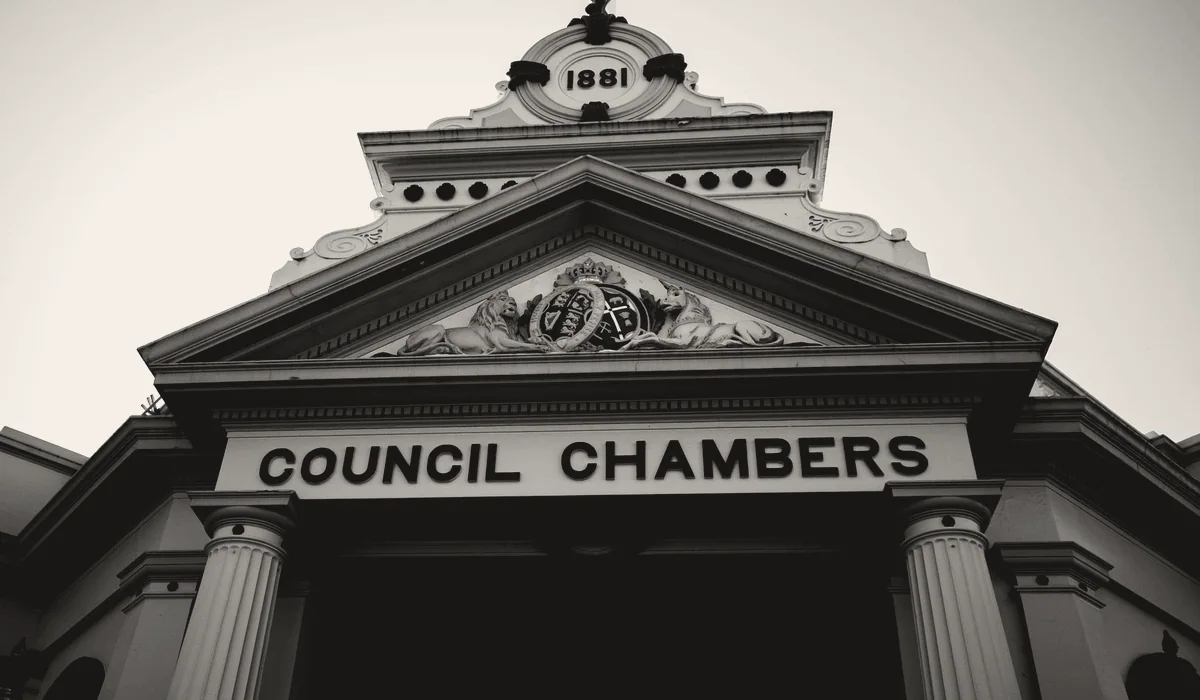
Local authorities: planner, funder, landowner and eventual custodian
Local authorities commission public art in more roles at once than any other body, and the conflicts that creates are structural rather than accidental. A council running its own commission can also be the planning authority that required the art, the funder holding the money, the landowner granting a site, and the custodian maintaining the work for the next forty years. Those four roles have different interests. The planning side wants the obligation discharged, the estates side wants no new liability, and the arts or regeneration officer wants a work worth having.
Councils commission through a public art policy or strategy adopted at local plan level, through capital projects such as a new library or a public realm scheme, and through funds pooled from planning obligations. The published policy is the document an artist should read before the brief, because it states what the authority thinks public art is for, and the brief will have been written inside it.
Developers commissioning under a planning obligation
Private developers commission public art because a planning permission told them to, and this is probably the largest single source of public art commissioning in the UK by volume, though no published dataset breaks UK commissioning down by client type and the claim should be read as practitioners' experience rather than as a measured figure. The mechanism is a planning obligation: Section 106 of the Town and Country Planning Act 1990 in England and Wales, Section 75 of the Town and Country Planning (Scotland) Act 1997 in Scotland, and an equivalent planning agreement route in Northern Ireland. The obligation is a legal agreement between the developer and the planning authority, and it usually specifies a sum, a location and a deadline rather than a subject.
Two things follow from that for anyone answering such a brief. The money is real and already committed, which is unusual. And the developer's primary interest is discharging the obligation on programme, because the obligation is often tied to occupation of the buildings, so the timetable is driven by the construction programme and not by the art.
Percent for art sits alongside this. It is a policy convention, commonly expressed as around one per cent of the capital build cost, adopted by some planning authorities and written into their local plan. It is not law in the UK, and where it bites it bites through the planning obligation, not on its own.
Health boards, universities and transport bodies
Health boards, universities and transport bodies commission for reasons internal to the institution, which makes their briefs the most specific of any client type.
- NHS boards and trusts commission for clinical estates: wards, entrances, courtyards, waiting areas and mental health units. Infection control, cleanability, sightlines, fire loading and patient safety are hard constraints, and they eliminate whole categories of material before aesthetics is discussed. Funding frequently comes from a hospital charity rather than the clinical budget.
- Universities and colleges commission for new campus buildings, donor-funded projects and public realm between buildings. They have an estates department, a capital programme and usually an internal committee, and their work tends to be permanent because the landholding is stable.
- Transport bodies commission for stations, interchanges, bridges, cycleways and depots. Rail and highway environments impose the tightest safety regime in public art: everything must survive vandalism, weather and cleaning regimes, must not distract drivers, and must be maintainable during possessions or road closures.
Trusts, housing associations and schools
Charitable trusts, housing associations and schools commission at smaller scale and with different accountability. A housing association commissions for estate improvement and new development, and its tenants are both audience and stakeholder, which makes consultation a genuine part of the brief rather than a formality. A charitable trust or a foundation may commission directly for a site it owns, or fund somebody else's commission, and in the second case its reporting requirements land on the commissioner as an extra layer of documentation.
Schools commission the smallest budgets on the list and often the most participatory work, frequently funded by a parent association, a small grant or a capital refurbishment. The constraint that catches people is not money but safeguarding and site access: an artist working in a school is working around a timetable, a caretaker and a disclosure check, and the check is a different one in each jurisdiction: the Disclosure and Barring Service in England and Wales, Protecting Vulnerable Groups scheme membership through Disclosure Scotland in Scotland, and AccessNI in Northern Ireland.
Under what duty, exactly
| Commissioner | What obliges them | Who holds the work afterwards |
|---|---|---|
| Local authority | Its own adopted policy or a capital scheme | The authority, on its asset register |
| Developer | Section 106 or Section 75 planning obligation | Often transferred to the council or a management company |
| NHS board or trust | Estates strategy, or a charity's grant condition | The board or trust |
| University or college | Capital project or donor agreement | The institution |
| Transport body | Scheme design standards or a planning condition | The infrastructure owner |
| Housing association | Development programme or resident priorities | The association |
| Trust or foundation | Its charitable objects | Whoever owns the land, by agreement |
| School | A capital refurbishment or a specific fund | The school or its local authority |
The third column is the one to check before agreeing anything. A commission whose eventual custodian has not been identified in writing is a work with no maintenance budget, and the transfer of a developer-built work to a council or an estate management company is a negotiation that can outlast the artist's involvement by years.
The advisory panel, and who actually decides
A public art advisory panel advises; it very rarely decides. Councils, health boards and universities commonly convene a panel of five to nine people, drawn from officers, elected members or governors, a curator or arts professional, a community representative and sometimes an artist, to score submissions and recommend an appointment. The recommendation then goes to whoever holds delegated authority, which is usually a named officer or a committee.
Anyone answering a brief should establish two facts about that structure: whether the panel's recommendation is binding, and whether any party outside the panel holds a veto. A commission with an advisory panel and an unnamed final approver is the arrangement that produces late design changes, because the person who can say no has not yet been in the room.
This site does not rate, recommend or list commissioning agencies, consultants or artists, and it names no organisation as a service. Where bodies appear above, they appear as categories of client, because knowing which category a commissioner belongs to is what tells a reader how the money, the timetable and the eventual liability will behave.