Commissioning a mural: what it costs, who has to agree, how long it lasts
Commissioning a mural in the UK costs £2,000 to £20,000 for the usual case, a painted exterior wall of 20 to 100 square metres, and the price is set less by the artist than by the wall: its area, the access, the surface condition, and the coating that goes on last. A mural commission has an image painted onto a surface somebody else owns, for a period shorter than the commissioner assumes. It is one of the cheapest forms of public art to commission, the one most often reached for on a small budget, and in its two common systems, aerosol and acrylic, the design life is under a decade.
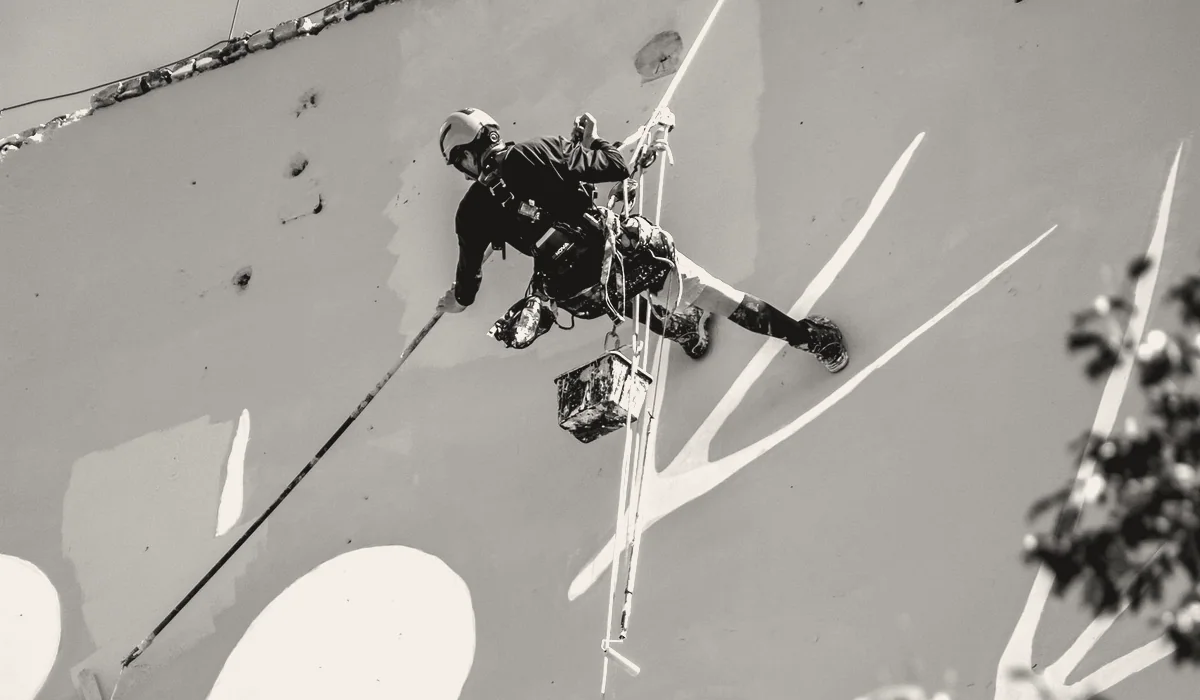
Paint is the cheapest item in the budget, and the wall's owner, not the payer, controls how long the work lasts.
What a mural costs, and the four variables that set the price
Four variables set the price: painted area, access, surface condition and finish. Area is priced per square metre, and flat-colour work sits at roughly £50 to £250 per square metre of finished wall. Photographic realism, portraiture and lettering sit at the top, being slow rather than costly in paint. No UK body publishes a price index, so the bands below are working ranges, not survey data, narrowing £2,000 to £20,000 by area.
| Scale | Access | Working budget |
|---|---|---|
| Small wall, 20 to 40 m2 | Ladder, podium or tower scaffold, from the ground | £2,000 to £7,000 |
| Mid-scale, 40 to 70 m2 | Tower scaffold or small powered platform | £6,000 to £14,000 |
| Gable end or large format, 70 to 100 m2 | Full scaffold or tracked platform, traffic management | £12,000 to £20,000 |
No band is quoted for walls under 20 square metres or over 100: they are priced per square metre against access, and a tracked platform with a road closure carries a large gable past the top of the table.
Inside any band the budget splits eight ways: design fee, access and traffic management, surface preparation, paint, protective coating, painting days, insurance and licences, documentation. Access is the site works line, 10 to 20 per cent before any paint is bought. The design fee is the artist fee line, 15 to 25 per cent, payable whether or not the wall is painted, because the design is what gets approved.
Artist day rates are not standardised in the UK. The a-n Artists Information Company and the Scottish Artists Union publish guidance used as a reference point, and no rate of that kind is quoted here. Prices for digital art commissions belong to a different market, the freelance illustration economy, and do not transfer to a wall.
Who has to agree before anyone paints
Agreement is needed from up to four parties before a mural can proceed, and the wall owner is only the first of them.
- The wall owner. Get a written licence, not a verbal yes, naming the design, how long the work may remain, access during painting, who cleans it, and what happens if the building is sold.
- The planning authority. Painting an existing wall is usually not development needing permission. Four things change that: a listed building, where listed building consent is likely; a conservation area, where painting a previously unpainted elevation can need permission; anything advertising a business, which brings in advertisement consent; and fixings, projections or lighting.
- The highway authority. Scaffolding or a platform on the footway needs a licence and a lane closure needs traffic management, both booked weeks ahead.
- The landlord behind the wall owner. Housing associations, rail and canal bodies, schools and NHS estates run their own approval routes, routinely slower than planning.
Surface preparation and the coating that decides the lifespan
Surface preparation is where a mural budget is quietly won or lost: paint on a failing substrate fails with it. Five steps: survey for damp, salts, spalling and previous coatings; make good the render or pointing; wash down and allow full drying; apply a stabilising primer; then the basecoat the artist paints onto.
Three paint systems dominate exterior mural work in the UK, and they behave differently:
- Acrylic masonry paint gives good coverage and a wide mixed palette, and is the default for painted-wall commissions.
- Mineral silicate paint bonds chemically to masonry rather than sitting on it, is highly lightfast, and lasts longest on sound brick, stone or lime render.
- Aerosol paint applies fastest, has the widest ready-mixed colour range, and fades soonest: reds, pinks and fluorescents go first, sometimes within two summers on a south-facing wall.
Anti-graffiti coating is a maintenance decision, not a finish one. A sacrificial wax coating comes off with hot water along with whatever was sprayed over it, so it is reapplied after every clean; a permanent polymer coating survives repeated cleaning but is harder to apply and shifts the sheen. Test either on a sample panel: both alter colour depth.
How long a mural actually lasts
A mural lasts between 2 and 25 years, and the paint system is the strongest predictor.
| System | Realistic life before visible loss | Main failure mode |
|---|---|---|
| Aerosol, unprotected | 2 to 5 years | UV fading of warm pigments |
| Acrylic masonry paint with UV-stable topcoat | 5 to 10 years | Chalking, then flaking at edges |
| Mineral silicate on sound masonry | 15 to 25 years | Substrate failure rather than paint failure |
Aspect, damp and pollution move all of those figures. A north-facing sheltered wall outlives an exposed south-facing one by years, and rising damp blows the paint off regardless of specification. Write the design life into the contract, with who pays for touch-up, who decides the work has reached its end, and who removes it. Moral rights under the Copyright, Designs and Patents Act 1988 give an artist the right to be identified and to object to derogatory treatment, but no right to stop a wall being repainted.
How long the commission takes
The commission takes about 3 to 6 months from brief to finished wall once consents, licences and access are counted, short by the standards of public art: a permanent sculpture runs to around 18 months. Painting is 3 to 15 days on site. The compressing factor is weather: most masonry systems need a dry substrate and air above about 5°C, which narrows the reliable UK window to roughly April to October and makes an autumn start a gamble.
Where mural opportunities are published
Mural commissions reach artists by four routes: an open call, an invitation to a shortlist from a local authority roster, a direct appointment where budget and timescale are small, and a participation project where the artist works with a group. The last is a different job, contracted differently, and priced with workshop days from the start.