 by
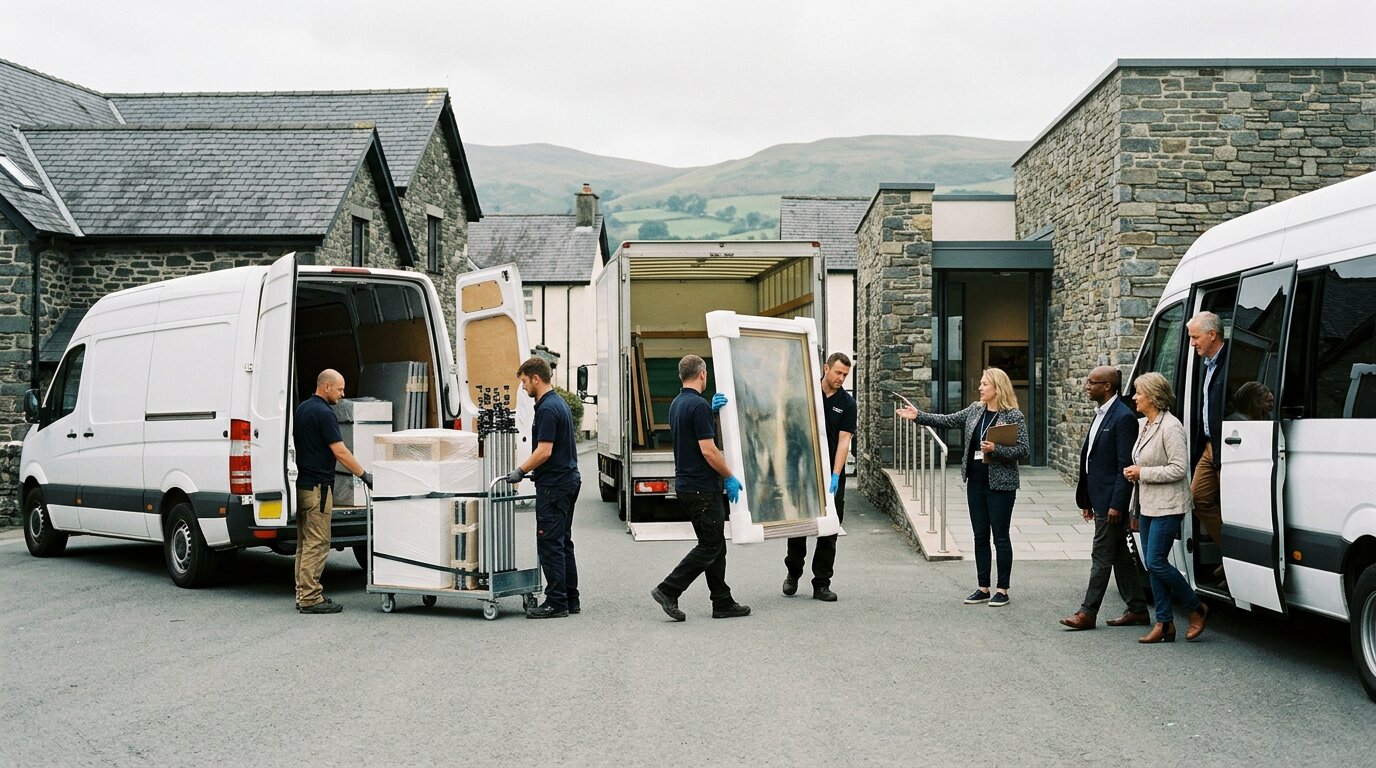
Most small exhibitions have three different things on the move at once: visitors, display equipment and the artwork itself. They need different vehicles, different people and different levels of care. Treat them as one "transport" job and the artwork usually ends up wedged between a folding table and someone's rucksack.
The plan below separates the three, then brings them back together at the venue door.
Start by listing what is actually travelling
Before you look at any vehicle, write three short lists:
- People: artists, volunteers, invited guests, any group coming to the opening.
- Display kit: plinths, screens, lighting stands, tables, signage, a hanging system.
- Artwork: each piece with its size, weight, fragility and value.
The artwork list decides almost everything else, so do it properly. Note the dimensions with packing, not just the canvas size.
Know when the artwork needs professional handlers
A self-drive van is fine for robust, low-value work that the artist is happy to wrap and strap. It's the wrong choice for anything valuable, very large, glazed, on loan from someone else or covered by an exhibition insurance policy that names an approved carrier. In those cases, check the lender's and the insurer's conditions first. Specialist fine-art transport brings crates, climate control and handlers who do this daily.
If you do move work yourselves, keep it simple: wrap each piece, stand flat work upright on a soft base, strap it so it can't slide, and keep it apart from the heavy display kit. Photograph every piece before loading and again on arrival.
Display equipment: a local van enquiry in Machynlleth
Plinths and screens are bulky but tough, and they're often the reason a van is needed at all. If the event is in or near Machynlleth, one place to ask is the walesrentals.uk page with vehicle hire information for Machynlleth. The page describes car, van, minibus and truck rental and says bookings and enquiries are by phone. It doesn't list specific vehicles, so ask what is actually available and how long the load space is before you count on it. Allow for the van's height if the venue has a low arch or a tight yard.
Visitors: a minibus from Cardiff
An opening in Mid Wales can draw a group from the south. Moving them together is easier than coordinating a dozen cars. If the group starts in Cardiff, you can look at Cardiff minibus hire options. The site lists seven-seat people carriers and minibuses up to seventeen seats, and states its own age and licence requirements for the larger vehicles.
Check the driver's licence against GOV.UK's licence categories before booking. A car licence passed on or after 1 January 1997 covers vehicles with up to eight passenger seats, and category D1 covers up to sixteen. A car licence stretches to a minibus with up to 16 passenger seats only in the narrow circumstances on GOV.UK's minibus page: no payment from or on behalf of passengers, a driver aged 21 or over with two years' licence driving voluntarily for a non-commercial body, no trailer, and a maximum authorised mass of no more than 3,500kg (4,250kg for electric or hydrogen vehicles), among other conditions. Otherwise check your licence entitlement and the hirer's terms, and get the hirer's answer in writing for the exact vehicle. Minibus passengers travel in the seats, with belts. Don't plan to carry artwork in the aisle of a full minibus.
Confirm venue access and collection
Every venue has its own rules about arriving with vehicles, and they're easy to check in advance. Two examples show the kind of detail to look for:
- MOMA Machynlleth says its nearest parking is the public car park on Heol Maengwyn, and its access page says the only parking at the centre is blue badge parking at the back, which must be booked in advance.
- National Museum Cardiff asks groups to pre-book and says the two coach bays in front of the museum are ideally for setting down and collecting only.
For your own venue, ask: where can a van unload, for how long, and is there a lift or step-free route to the hanging space? What time can you get in the day before, and what time must everything be out after the closing day?
If the event includes an installation rather than a straightforward hang, add the questions a commissioner would ask on installation day: how heavy or awkward pieces reach the site, how close a vehicle can get to the installation point, and who agrees the access route and timings with the venue.
Exhibition-day transport matrix
| Visitors | Display furniture | Artwork | |
|---|---|---|---|
| Vehicle | Minibus or shared cars | Self-drive van | Artist's own vehicle, or specialist art transport |
| Who is responsible | Named minibus driver | Volunteer with the right licence | Artist, or the carrier named by the lender or insurer |
| Key check | Licence category for the seat count | Load length and height against venue access | Insurance conditions and condition photos |
| Arrival | Set-down point, then park elsewhere | Unloading slot agreed with venue | After the furniture is in place |
| Departure | Fixed pick-up time | After artwork has left | First out, checked against the list |
Look down the "Artwork" column. It arrives once the furniture is set up and leaves before anything is dismantled, so the paintings are never in the room while plinths are being carried about. If the matrix shows a single van doing all three jobs, that's usually the moment to rethink.
