 by
A commissioned or exhibited work that started life in Essex can travel. Plenty of small companies, artist collectives and community arts groups take an installation, an exhibited piece or a workshop programme north for a run of dates. What usually goes wrong is not the art. It's the transport, and specifically the habit of trying to solve everything with one vehicle.
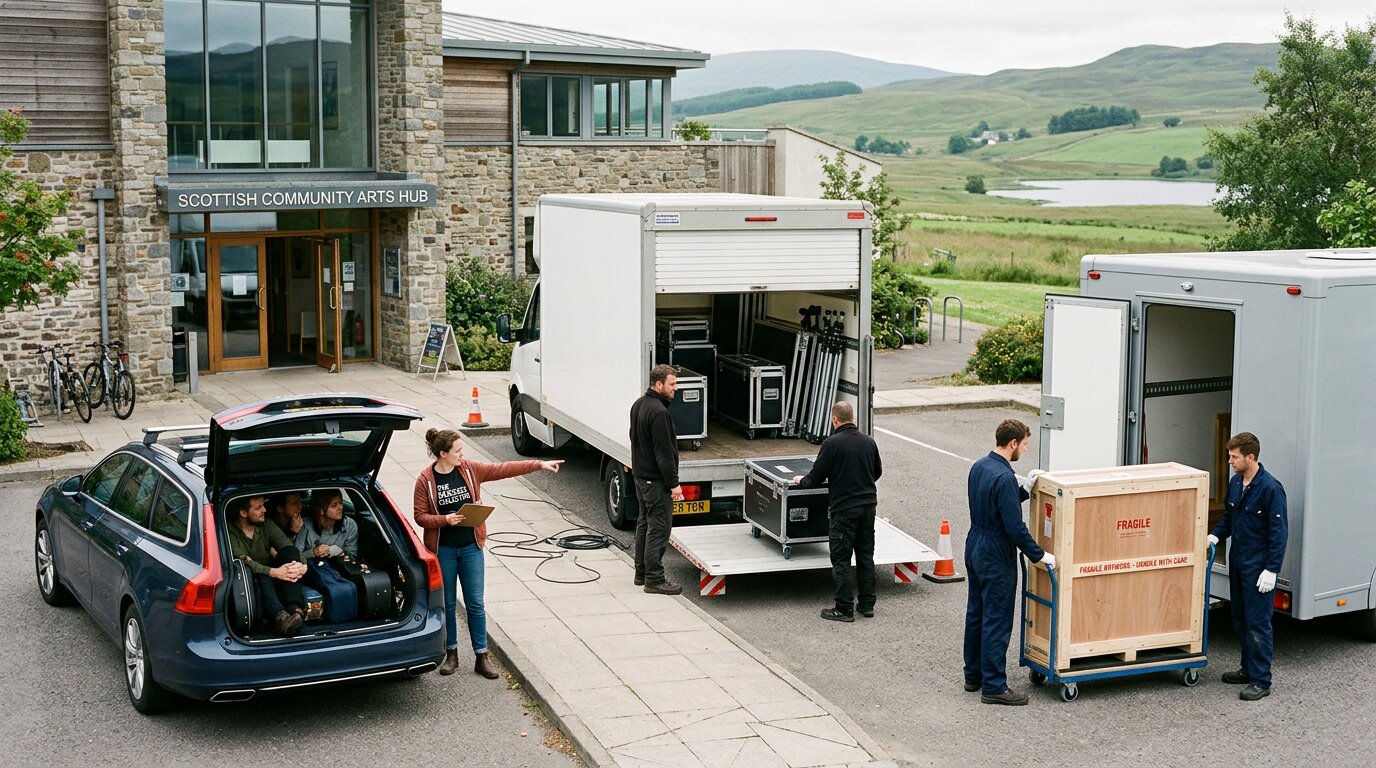
A touring production really has three loads: the people, the general kit, and anything precious or fragile enough to need specialist handling. Each has its own vehicle question, its own licence question and its own person in charge. Split them on paper early and most of the later problems shrink.
The production transport brief
Here is a hypothetical brief for an invented project: a small Essex arts company touring a participatory installation to venues in Fife and central Scotland over ten days. The numbers are illustrative. The structure is the point.
| Staff | General equipment | Specialist objects | |
|---|---|---|---|
| What it is | Two artists, a producer and a technician | Staging flats, lighting stands, cable boxes, workshop materials, folding tables | Six framed original works and a borrowed sculpture |
| How it travels | Train or car north, then a hire car for local venue days | Hire van or light truck driven by a named team member | Fine art transport agent, or a confirmed loan arrangement |
| Licence and paperwork | Standard car licences; check each driver is insured on the hire | Check vehicle weight against the driver's licence; check whether an operator's licence applies | Lender's insurance and packing conditions; condition reports |
| Venue questions | Parking for the team, building opening times | Loading door size, get-in time, where the vehicle waits | Secure storage overnight, environmental conditions, who signs for it |
| Owner | Producer | Technician | Producer, with the lender |
Notice what isn't in the table: anyone riding in the back with the staging. People travel in seats. Cargo travels in the load area. No exceptions on a long tour, when tiredness makes shortcuts tempting.
Staff travel: plan the venue days, not just the long drive
The long journey north is the easy part to picture. The harder part is the daily pattern once you arrive. Venues in small towns can be spread out, start times differ, and a technician may need to be at a venue two hours before the artists.
Worked example one: a hypothetical week in east Fife
Imagine the four-person team has a week of workshops in community spaces along the east Fife coast. They travel north by train with personal luggage only, because the kit is travelling separately. On arrival they need one car for the week to move between venues and their accommodation.
For that, the car hire information for Leven describes cars from economical models to estates, says the service covers Leven and surrounding areas from a Glenrothes depot, and offers delivery and collection. The producer would ring with the dates, the drivers' names, the delivery address and the number of people travelling, then confirm insurance for every named driver, the deposit and whether a car with enough seats is actually available. Four adults plus daily bags is a five-seat car with room in the boot, not a van.
General equipment: match the vehicle to the load and the licence
Staging and technical kit is where vehicle size climbs quickly, and with it the rules. A standard car licence covers vehicles up to 3,500kg maximum authorised mass. Above that, category C1 covers vehicles between 3,500kg and 7,500kg, according to GOV.UK's licence categories. A 7.5-tonne box truck needs a driver with C1 on their licence. Check every possible driver's entitlement before you choose the vehicle, not after.
Weight also affects paperwork. GOV.UK says a goods vehicle operator's licence is needed if a business uses goods vehicles with a gross plated weight over 3,500kg, and it lists some exemptions. Whether that applies to a particular arts organisation and vehicle is a question to settle with the guidance and the hirer early on.
Worked example two: a hypothetical get-in near Falkirk
A separate, invented case. The same company's staging set is too big for a Luton van once the lighting stands and flats are counted. The technician holds C1. The tour's first central Scotland venue is near Falkirk, so the plan is to hire a light truck locally, collect the set from storage, run the get-in, and keep the truck for the move to the next venue.
The Falkirk truck hire options page lists trucks from a 3.5-tonne Luton with a tail lift and 7.5-tonne box trucks with tail lifts through to much larger lorries, and says delivery and collection in Falkirk and nearby can be arranged. The technician would ask for the exact vehicle's plated weight, load length, internal height and tail-lift capacity, and check the box height against the venue's loading door. A tail lift helps with flight cases. It won't solve a get-in that runs up a flight of steps.
The Leven and Falkirk pages share a phone number, so they appear to be part of the same hire network rather than separate competing firms. They're used here only because the two examples happen in different places.
City centres and emissions zones
If the tour includes a city venue, check the vehicle before you drive in. There are four Low Emission Zones in Scotland, in the centres of Aberdeen, Dundee, Edinburgh and Glasgow, according to mygov.scot, which links to an official vehicle checker. Ask the hirer for the registration in advance and run it through.
Specialist objects: don't put them in the hire truck by default
Original artworks, loans and anything irreplaceable sit in a different category. Guidance on touring exhibitions from the museum sector, including an ICOM UK presentation on touring logistics, describes appointing a fine art transport agent early and agreeing schedules, packing and venue access with them. If a lender is involved, their insurance and packing conditions decide how the work travels, not your budget for the truck.
For a small project, the honest answer is often that the framed works go with a specialist or, where the owner or lender agrees, travel in a car with the producer, well wrapped and never left unattended, while the truck carries everything that can be replaced.
If the tour ends in an installation and handover
Not every tour comes home with everything it took. If the last stop is a venue or commissioner taking on a work permanently, treat installation and handover as a stage of its own in the transport plan. Agree in writing who is responsible for the work at each point in transit, who signs it off on site, and when responsibility passes to the receiving organisation. The truck booking and the handover date should then match, so nobody is unloading a work that the client isn't ready to accept.
Assign the return journey before you leave
Tours end tired. Decide before departure who returns each vehicle, where, and by when, who checks the load area is empty, and who collects the specialist objects from the last venue. A tour that started with three clear loads should end with three clear hand-backs, each with a name next to it.
